Saturday, 16 April 2011

Let Them Ingest Saccharine
Reality tellingvision 'talent' shows, aside from being another hastily buffed facet of the bread and circus, alpha-wave inducing media triviosphere, also I believe, serve to substantiate and maintain an ugly and inevitably destructive cultural and social paradigm. The Celebritocrats lean over us from their polished pedestals, purporting to be our salvation, overseeing the next chosen one's ascent into their domain, casting aside all those deemed unworthy to be stood before their vapid (pay no heed to the man behond the mirror) visage. How easily the discomforting pornography of schadenfreude that parades in the initial stages of these shows seems forgotten; contestants disposed of, 'deleted', mercilessly and without recourse, culturally guillotined whilst the baying hoardes jeer and mock.
The first myth that these events promulgate is that of audience (electorate) participation in outcome, that is bolstered by the temporary feeling of belonging that comes from a large (in this case discomfortingly vicarious) social event. When the babblers return to their workstations in the morning, in thrall to the egregore of the collective experience; the party; the club; the rally, the social rewards of collective experience manifest; jokes, taunts, desires, communications, only now ironically combined with the sense of strength and self determined identity that comes from taking sides. The truth however is that such limited participation detracts from genuine choice and opinion, and undermines the value of the thought and effort that are required to make such, and much like our stately 'democratic' politics, one is voting between what has already been chosen/provided.
The second myth which has become deeply pernicious in our post-boomer age of financial clemency is that of meritocracy, and its cousin aspirationalism; the jovial notion that you get what you are 'entitled' to, that your talent will be recognised despite any impediments, that you can rise to the 'top'. On the surface it seems a madness to argue with such concepts, what could be more reasonable than wanting to do well in your life and being rewarded for gumptive observance, but when analysised we discover a deeply selfish, pathological philosophy, mascarading as fairness under reason and even morality. It is in fact much closer to the lottery; that other manipulator of social and aquisitional hope; taxing dreams.
Merit is always awarded and administered by a subjective higher agency in this paradigm, conferred onto a candidate by an 'expert' adjudicator, and as such merit is determined by an adherent promiximity to the predetermined notion of excellence, a conformity to a limited 'usefulness'. In this highly managed heirarchical caste/clique system that we are indentured to, the ladders are few and greasy, the waiting lists are long, and the parameters demanding; the adjudicating experts being more often than not venal, self-serving and dogmatically ossified.
The Celebritocrats themselves are lifted into their guilded positions and held there only so long as they are useful/beautiful/interesting, by thems lurking higher up the media pyramid than they, even though their own fevered egos would decry it. Half-wittingly they are using these shows as a platform to substantiate the carosel of their own image, but more importantly the very notion of the validiy of the Celebritocratic class itself. At least Strictly doesn't piss about and removes the public from the performance altogether, literally feeding off their fantasies without shame. They are a small caste but they saturate the mediasphere with their tales of woe, abs, petty wants and rags to riches fantasies, distracting the eager, drooling, expectant from anything of import, nevermind concern, whilst undermining the real achievements that people can and have made. Let them ingest saccharine.
Pay No Heed To The Man Behind The Curtain (or are we blundering blindly?)
Thursday, 10 June 2010

The Art of Seeing (or, 'Pay Attention' the Parrots cry)
Photography is a curious art. It instills no surprise in me that 'unmodern' cultures used to find these instruments anxious; I myself am still mildly confounded by this technology even though I was born into a culture and time that has favoured it ubiquitously, whilst also becoming equally negligent of its power. To capture a moment for a relative eternity, one that previously had only existed as a fleeting sensorial passing, is a profound act; a gross act, in the mind of some.
Photography has a paradoxical relationship with the 'real'; the camera can act as a shield and as a distractor, but it can also act as a tool for the extension of sight and insight. Consider a typical tourist casually snapping their way around a new experiential environment, moving on to each new land-mark or vista, pausing only so long as each click of the shutter, seemingly distracted (as we have come to constantly be) by a permanent act of pre-remembering. The captured images serve to act as experience, especially when they are witnessed live on a reactive screen, and secondarily they serve to act as memory and prop up the recollective narrative of that experience. Memory is notoriously fallible and malleable, and the photograph steps in to redefine it, often to negate. Unfortunately most photography is of this nature, and has become increasingly so with the spread of digital technology; the act of attention is being lost in a deluge of vapid and distracting images.
Conversely, photography has the power to focus attention, on the moment and on the subject matter; there are few things that have the power to elicit an emotional response so concentrated, as a well considered (lucky) and attentive photograph. Although the camera can distantiate the photographer from experience (there are many criticisms of the amoral, opportunistic, even voyeuristic stance of the photographer), it can also draw them into the very depths of it. Whether one has traveled into a war-zone and milled amongst victims and aggressors, or spent long minutes on knees in spring bracken observing the shapes and forms of ones quarry, it is clear that such observation provides a significant meditation on awareness. From this perspective the outcome of the art is secondary, no matter the effect on a later witness; what matters is the intense evanescent experience of the observer in their transaction with the observed. Every moment passes unique and fleeting, never again to be witnessed in similitude.
The image has increasingly come to dominate our experience, as the desert of the real shrinks back into shadow against the bright edges of our screens. Our lives are conducted increasingly vicarious through machines, and our dreams and fantasies are manipulated by the hyperreality of our media. We have long since crossed the threshold into this space of Baudrillard; yet even though he warned of our wanting wanderings across this land, the territory is expanding, recapitulating and reinventing itself, unhampered and unnerving. Reality has in effect become the thing that is now difficult to experience, as opposed to dream; simulations and simulacra have superseded the real as so-called celebrities prance on computer generated backdrops with airbrushed skin and photoshop-ed waistlines, and previously inconceivable animated vistas dazzle our expectations and keep us from stepping out to experience those that genuinely exist.
Such technology now has such a grip on us that we feel anxiety when we are separated from it and we seem to be losing the ability to focus on anything properly for any longer than a few moments. Similarly this constant reiteration and improvement of the Nu, goads us blindingly into over-consumption so as to satiate our wants, whilst terminal dissatisfaction haunts us. The soul hole that yearns for deep contentment not only cannot be filled by such false succour, but it also expands exponentially in response to this diet.
We are in a perilous state, every current action is vital. We have come to treat each other like the commodities we have been encouraged to acquire and shortly dispose of. Most of our notion of 'love' has been manipulated by the desire for access to acquisition, whilst ironic romance dramas and comedies tantalise us with delirious hopes from beyond the screen, as we displace and dispose (delete) of companions like we do our mobile phones.
Beware the image. Beware the hyperreal. Disobey the tellingvision. Learn the art of the photographer, the art of attention; the art of seeing, but be very warey of his creations, for they are not always as real as they seem.

Thursday, 12 November 2009
Flush It All Away
In the 'modern' world we take for granted our sinks and toilets, and their capacity to remove the manifestations of our indulgences, but how long have we had this fortunate technology? Archeologists have discovered evidence for one of the first flushing toilets in ancient China, but who can really know? Certainly the Romans were known to have a relatively sophisticated set-up using sluices and gravity to channel the bodies' outpourings away from their owner, but such facilities would only be for the use of the exceptionally privileged, and really only moved it somewaht further away from the nose of the do-er. Today, in the wealthsome corners of this world, such technologies have become ubiquitous. The ever-present toilet as we recognise it, with its sophisticated flush plumbing, was a Victorian invention called the night commode, an extrapolation of earlier models with built-in bed pans, that more than ever necessitated upon the vast Victorian sewer building projects. Once more, such devices began as the sole preserve of a notional aristocracy, and prior to the pull and slosh of the flush into the sewer, would have been the servant, to whisk it all away.
In older pasts, humans made little of mess and waste that could not be readily re-sorted into the environmental matrix, nothing that could seriously pollute, or not be eaten by something or other. Bones, cunningly shaped stones and footprints, were typically the only things we could leave in our wake, humanure squat into existence a little ways from camp, perhaps in a hole, but as such, always there to confront us. With the invention of the flushing toilet, all of this changed; the foul botherings of our bowels could be removed from sight and being with but a jaunty tug and a porcelain gurgle. It can therefore be understood that the advent of the flushing toilet can be seen to be blamed for all of our current problems of pollution.
Obviously I'm being facetious, the problems of waste and pollution are extremely complex, yet on a simple psychological level, this enabling facilty of removing one's waste from one's sight, and so escaping the consequences of having to deal with it, is profound. In more recents pasts, humans have conjured with their ingenuity all kinds of infrastructures and industries for removing and hiding waste, and in parallel, increasingly sophisticated and insidious pollutions. It therefore bears considering that the commode can be seen as a metaphor for all blasé waste disposal, in that washing powders, shampoos, toothpastes, micturated pharmaceutical metabolites and other glorious effluents now flow down the drains with your poo, removed from sight and cognisance.
The problem of pollution has to a certain extent crept up on us while we sleep-walked, in that the majority of historical waste was readily degraded by nature. Unfortunately, modern pollutions are not always so easily disposed of. In the last hundred years or so, with advancements in science and technology, we have seen the appearance of plastics and other petrochemical derivatives; complex novel chemistries previously unknown to the biosphere. Some of these chemistries have been released into the ecosystem of Earth with very little care or awareness of their consequence, caution was not erred. The environment however is not a laboratory and unexpected or unintended consequences are still consequences. Some familiar examples include PCB's and DDT and the endocrine disruptors of more recent renown.
We can trace this recklessness back into the past, to when the world was vast, environmental consequences were slight and fevered dieties reigned over matter anyway. With the advent of agriculture came domesticity, and ironically that which had bound man to the land was also to drive a wedge between them. Cities separated people from the soil, both physically and psychologically, even though these cities relied on agriculture to sustain them. A limen of perception manifested in the urban dwellers, nature became increasingly exteriorised and distant, this division catalysed by anthropocentric religions and philosophies. More and more the veil became opaque, the plasticised limen thickened; light pollution blotted out stars, shrinking context; food appeared by magick in plastic packets, convenient wrappings which also conveniently disconnected us from its origin; ugly sanitised social planning forced us into lawned toy realms and gated yards, or worse still concretised monoliths devoid of any kind of sympathy to environment or empathy to the needs of the spirit. Reality increasingly became a life vicarious, lived through screens and devices, the biosphere now an abstract, its direct 'experience' becoming another novel product, or a desirous holiday destination. Meanwhile, all of the cities' waste was carried away by new, uncomplaining, technological minions.
We do have a problem here, both psychologically and physically, I am no luddite, but the plastic limen is now manifesting serious repurcussions; polluted water-systems; whales dispossed of as toxic waste because of high concentrations of volatile organic compounds; seas filled with plastic bottles; shrinking and collapsing habitats, abandoned to the vicissitudes of necessity and frivolity; etc. etc. On a local level we have littered streets and countryside, abused animals, toxins permeating our foods and water, and all of this exists alongside and operates in a vicious cycle upon an entrenched, unwholesome culture of ignorance and disrespect (occasionally enforced and glorified) towards both each other and our environment. The common lack of direct felt presence of the wild, of living systems and things, I believe, has made us miserable, because such witnessings feed our imagination and enrich our experience, simply because nature is beautiful, and to be occluded from it, is a huge social and spirtual loss.
Monday, 7 September 2009
Our Spaceship Earth

I feel compelled to write a short something in praise of a film that I was lucky enough to stumble upon the other day. The film is called 'Home'; a paean to our planet, directed by the photographer Yann Arthus-Bertrand, well known for his stunning and emotive aerial photography. 'Home' combines this photography (in motion), with a gentle and intelligent narration about the history of our planet and our species.
I was initially ambivalent about the concept of a voice-over, having very much enjoyed similar visual cinematic pieces, like Ron Fricke's Koyaanisqatsi and Baraka, that simply employed an emotive soundtrack to complement a sequence of imagery that was intended to tell its own tale, leaving the viewer to construct their own interpretation and emotional response.
Home's monologue is however, exceptionally sensitive, both to the imagery and the viewer, and is surprisingly unsententious, being poetic and informative, yet unobtrusive. The intent of this work I believe, is to emphasise whole-istic thinking against reductionism, and to negate the separation of Homo Sapiens, both physically and psychologically, from the natural world. Rather than being part of its continuum, a facet of the dynamic meta-organism that is Earth, we have to come to see nature as somehow external and separate and ourselves conversely as hallowed and special.
The style of aerial photography also reminds us that we place ourselves (and are placed) in a personal, local sense of scale and limited awareness (both of size and time), and a cultural (religious? scientific?) context, because it shows us an effectively new perspective. Similarly, our habit of mental dividuation, our faith in the validity of our own temporal 'reality', and our innate fear of the vastly void of the unknown, can limit our perception, glorify ignorance, and make us too often oblivious to the consequences of our behaviours.
The philosopher John Gray has spoken sardonically and ironically about somehow removing or debasing our innate (yet often unrealised) biophilic inheritance, so as to prepare us for some potentially horrid grey prosthetic future. In contrast to such a dark intuition, 'Home' seeks to appeal to those better aspects of our character with an unpretentious simplicity, the vast, dynamic, integrated complexity of Earth speaks for itself; a universal, unambiguously valuable quality, that speaks through the simple pleasure of a walk in the woods, or the unveiling of an unexpected vista.
I heartily recommend this film to all of you, and hope you all receive as much from it as I have, and I suspect you'll also wish to share it with everyone you can. Home was made under patronage, seemingly with the intent to inspire and educate, and as such was released under a creative commons license, so it is free to share and show to all and sundry.
Home Homepage
Torrent Link
Tuesday, 25 August 2009
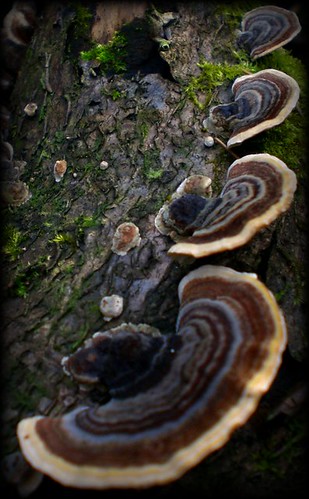
Mushrooms!

I never had much time for mushrooms when I was young; they weren’t particularly exciting to my immature self, they didn’t animate or change colour, and they didn’t seem safe. I can’t say I ever particularly enjoyed eating them either (there is little more offensive to my palate than poorly cooked mushrooms, slimey and crunchy simultaneously, in an eyeball popping sort of way). As I have grown older and more aware of the diverse complexity of our biosphere, I have found myself increasing enamoured of this often overlooked kingdom.
Mushrooms as we commonly recognise them, or toadstools for the more fantastically minded, are part of a vast and ancient kingdom of biology that has existed in some form or another since the dawn of life. Some of the first organisms to colonise land, were members of the kingdom known as Fungi. Classified as Eukaryotic, meaning cells with a nucleus, they are therefore similar on the cellular level to both animals and plants, yet distinct from both, although recently understood to be far more similar to animals than to the plants. The largest single organism known to man by area is a mycelial mat in Eastern Oregon covering 2200 square acres.
Fungi have been described as primary decomposers and molecular disassemblers; they are adept at utilising any available foodstuff, which can essentially be anything organic, and turning it into food. Fungi deconstruct dead and decomposing plant or other organic matter, and by doing so they not only continue their lineage, but return vital minerals and nutrients to the soil and food-chain. Fungi in the form of yeast have been used to ferment bread and beer for millennia, and similarly moulds have been used in various combinations with bacteria to produce an abundance of cheeses, from fermented milk curds. They can also generate complex, novel by-products, some useful: bacteriocides, immuno-modulators and profound psychoactive compounds (this meta-mind is a whole topic of discussion in and of itself) , and some deadly, and many we still don’t understand.
Many fungi are also symbiotic with various plant species, typically in the form of what is called a mycorrhizal association. These fungi form an alliance (non-moral) with the roots of a plant and provide various micro-nutrients and mineral salts to that plant, those that it would otherwise struggle to absorb, and in return the fungi extracts certain nutrients from the root system. This relationship is particularly tangible in healthy forest systems at this time of year, as the mushrooms begin to shoot up around the base of trees, particularly the deciduous here in UK. The actual organism exists underground: the mycelium, in association with whatever it is using as its food-source, or whatever plant species it has an affinity with, the mushroom being only a yearly sexual expression, a fruiting body, the tip of the proverbial iceberg. As a result of these relationships, one can measure, to an extent, the ecological age of a natural system by the diversity of is mushroom species and in turn its ecological complexity and hence relative health.
Another measure of health that can be construed from a diverse and healthy fungal population is our own. In our hyper-intensive farming monocultures, the mycorrhizal associations with crop systems have been drastically over-looked, originally through ignorance, but now through habit and managed indifference. The constant spraying of fungicides to counter parasitical fungal crop infections has had a devastating impact on the fungal diversity of the soil. Ironically this means that the crops are far less robust in themselves, and more fungicides and insecticides etc. are required to sustain them. Consequently the crops have also become increasingly deficit in minerals and micro-nutrients, a problem compounded by the fact the land is never left to fallow. It is no wonder that mineral and (the under-acknowledged) micro-nutrient levels are waning drastically in our common foods, and that we are beginning to find that this is to our detriment.
Anyway, back to mushrooms; now is the time to go and have a look at them, the plants are dying back and the rains are coming in, so the fungi are in their prime. Not only can they be beautiful in themselves, but the cycle of symbiosis that they are a part of is profound, and an excellent base metaphor for anyone that appreciates ecological diversity and its worth (nay - vital importance), or inclined towards emphasising the paradigm of collaboration over competition. They may even be growing on your lawn.
Paul Stamets: 6 Ways Mushrooms Can Save The World
(an excellent, informative and optimistic video, that every Evolver should watch, and the title is not as hyperbolic as one might think)
Mycorruption's mushroom photos
Medicinal Mushroom facts from wikipedia
Wednesday, 15 July 2009

Tuesday, 14 July 2009
Alpha
an ecosystem of mundane similarity,
the unrealised potential for complexity,
energies thrown together unbidden
to dance unimagined waltzes,
restless chaos eager to clamour
around a glimpse of novelty,
craving to look back upon.. what?
Sunday, 24 May 2009
..Money, Money, Money...Hope?
THRIVE: COMPLEMENTARY CURRENCY
Links to some of his essays:
Money: A New Beginning
Money: A New Beginning II
Money and the Turning of the Age
Friday, 24 April 2009
Ballard
The majority of people who recognise the name of JG Ballard, I imagine will do so because of the Spielberg film ‘Empire Of the Sun’ which was adapted from his semi-autobiographical novel of the same name, or for the controversy that surrounded the film ‘Crash’, another adaptation. Although many recognise his talent, he was always a somewhat peripheral writer, politely feral and unashamed. What I consider to be some Ballard’s finest work is his exegetic meta-novel, which began with the seemingly depraved, narcissistic indulgences of the super-solvent in ‘Cocaine Nights’ (in retrospection I have come to realise it started before that in the work of ‘High Rise’ with its claustrophobic atavistic tribalism), and concluded with the darkly populist frustrations of ‘Kingdom Come’. This corpus of work was intended to lead the reader through the writer’s preoccupations with the pathologies and irrationalities of neo-bourgeois existence.
There are many things to say about these novels, but of particular interest to me from this historical vantage, was his apprehension of a ‘middle-class’ rebellion; a revolution not of the oppressed or abused, but of the comfortable. The veil of self-deceit had been lifted from the promises of generalised aspirationalism, a culture that had left opportunistic palates super-saturated with everything that economical dominance could provide for them, but palates once so readily indulged were now found jaded. Deeper experiences and thrills were deemed necessary; simple 'decent' folks discovering the joys and fears of a little ‘bad behaviour’. This analysis of this dangerous backlash of the jaded palate came to dominate in the final books, ‘Millennium People’ and ‘Kingdom Come’, in which the rot had seeped further down the class chain, and the 'common' people had also come to wish for more than just their passive entertainments and single serving puddings, not because of the positive acknowledgement of such behaviours' vacuous pathology, but because of a primal selfish demand for more.
These emergent problems, he mused, were a result of the deeper self-satisfactory pathologies and status issues that lurk in all humanity, yet also reflected a growing reaction to the constant and terminal expectant promise of growth, and reiteration of the Nu. The next fantastic gum flavour, cleansing-wrinkle-stuffing-miracle-cream, or infinitely-animated-portable-monolith were ceasing to hold their desired effect. The insidious, interminable whisperings that come through the media from the corporatocracy, were no longer quite able to slay the anxiousness and frustration of an unrecognised unfulfillment, even though these same engines were feeding on such weaknesses. Product acquisitionalism had been found wanting, and no expensive watch or imaginative pizza topping was going to salve that. The engine of product creation had reached an apogee, tripping over it self, with availability of the Nu in opposition to the ever-increasing expectation for it; culture chewing on its own bloated tail like a lip-sticked Ouroboros.'
Deliberately, he narrates rallies and uprisings in familiar surrounds; in Malls and suburban driveways, in business parks and high-rises, ever-aware of the significance of setting. In the hyperbolic landscape of Psychogeography, it is always observed that the stage which the characters roam upon plays a pivotal role in a deeper understanding of the situation, be it a shopping centre, a housing estate or a political climate. The scene and context is as equal and as relevant to the dialogue, as any of the characters.
I believe Ballard's novels contain a significance that can be lost on a reader without a context for his ideas; complaints about lumpen characters and poor plotting often abound. A reader seeking entertainment or the finest prose, would find these books difficult (unless they had a trite taste for the unusual or macabre), because they require a large investment in the authorial conversation. Many of his writings are in a sense the re-workings of a theme; that of Ballard's important pre-occupational musings on human motivation, impulsion and pathology in general. He considered us to be somewhat sick and so our ugly simplistic populisms are satired and parodic parleys constantly aggress.
In unrequired defence, his are not stories in the simple sense, but rather the continually re-formulated and re-examined observations, of a long and intense self-dialectical conversation about human behaviour, focused primarily on our propensity for psychopathology in all its forms, ranging from the deeds of the individual to those of our collectives. There is a slight snobbishness in the critique of Ballard’s work, because he chose to use the form of the novel as a vector for an evolving didacticism, and many speak of smut and shock, but I think there is much to be learnt from them, if they are read with his intentionality in mind.

R.I.P.
Image by http://www.flickr.com/photos/catfunt/248129627/
Tuesday, 14 April 2009
Blundering Blindly
It has always been tempting for thinkers and historical observationalists to overlay a narrative onto to what they have known of the world; humans have a long and colourful history in the denial of contingency, in the art of myth, and of fevered teleological dreams. There is nothing in essence wrong with such a play so long as a humble agnosticism is maintained, and the myth building doesn’t spill into hubris. More promising has been the increasing acknowledgement and embracement of the value of uncertainty and the denial of universal absolutism.
Having struggled through the false-oppositional maze of recent human mental history, with all of its ontological gates and stiles, blacks and whites, and thrashed in the relativity of the post-modern void, we seem to be approaching a kind of tipping point, a seeming critical-mass of a particular awareness that is less anxious of the Vast. This awareness is one that is enabled to taste the universe anew, with a palate cleansed of outmoded notions, disabling dogmas, and the disastrous social ideologies that have been substantiated by the modern myth of progress.
The attempt to overlay new social systems onto ‘civilisation’ has always typically either been sinister or ridiculous; however, I certainly don't think we have seen the last of such attempts or of their avatars. Unfortunately narcissism, psychopathology and hypocrisy are the inevitable inhabiters of all such projects of forced social evolution. Social ideals and ideas are forged in a dangerous flame and their theoreticians are often flippant, enveloped as they are in their own personal fantasies, little imagining that their Utopia's might actually come to pass or come to literally smoulder in the recklessness of their derivative simplicity.
Personally it seems to me that in these troubled and troubling times, huge opportunities exist for fringe and novel thinkers, there exists a potential to embolden valuable and neglected memes, of ancient cultural practices and of futurist technologies; we cannot afford to limit ourselves. Not only can we feedback onto our environment, but we have the opportunity to do so consciously and with intent and a now relatively sophisticated historical cognisance.
Nevertheless I believe a time of great hardship and psychological dislocation is upon us, one that will test and terrify us all. In this time we will have to be very vigilant of ideologues and messiahs; there are many dysempaths roaming the hinterlands of our ‘civilisation’, some shunned and chained, others sadly we have elevated (or neglectfully allowed to rise) to the highest echelons of our societies, where they wreck and ruin. If we value our self-respect and our inchoate intellectual privileges, we cannot afford to keep blundering blindly into the future, whilst neglecting the lessons of the past.
Monday, 23 March 2009
An Elusive Quality
His book also provided me the first tentative glimpse at what I have come to know as systems theory, the deconstruction of the metaphorical motorbike could be perceived as reductionism, but to me the intent was always to emphasise not the individual parts or mechanism, but their place in a more complex and richer system, one that transcended their sum. My eyes widened. As such, I always assumed that Pirzig’s mechanical metaphors were informed by a deeper understanding and were designed to lead the reader into a more valuable insight of Universe. Although it is inevitably insignificant, I assume that my own experience of Quality has been innately and indelibly defined by natural observation in the way that his was. I consider that the natural world is the primary inspiration for all beauty and the origin of all genuine value. I believe Pirsig’s Quality is indubitably tied to that same observational experience, a sense of value which, I believe, we have typically become existentially occluded from and often effectively oblivious to.
In the modern word we are effectively separated from the natural, particularly what little is left of the wild, and by and large we live in urban sprawls, that are increasingly the creations of idealistic (and opportunistic) planners, agriculture has made it inevitable. Contrived architectural parodies and disposable culture now serve our needs, never-mind our desires, some being more ambitious than others in included some green to balance out the concrete (and I don’t mean lawns). As a consequence we have come to be abstracted from this quintessential Quality; value and worth are now defined by the cost and cultural significance of our acquisitions. The notions of ‘value’ and ‘worth’ as we have debase-edly come to know, are however concepts that snap viciously at the heels of all that are embedded in the dying paradigm of infinite acquisition and growth.
Many of the products and pointless objects that litter our lives exist because of the inevitable acquisitiveness and hierarchical nature of the prime-ape Homo Sapiens Sapiens, for we use such objects as indicators that define our place and position in the social matrix, that we are so frustratingly indentured to. We are rewarded for our passive collective observances and acquiescences with shiny baubles and fancy candies. Compare a Papua New-Guinean cargo-cultist wearing a piece of a torn Cornflake box in his head-dress to a bland branded fool walking down your typical high-street. I make a gross point there, but one that needs reinforcing occasionally.
Similarly I feel the need to speak of the notion of negative value. Many of the objects beholden of this temporal, abstract value system have been made (or their substrates sourced) by peoples of limited means and of typically brutal circumstance. It is seldom acknowledged that this is the case, or more likely comfortably ignored and forgotten, even though the situation has been often and capably articulated by thems that are keen to look, or rather unkeen to look away. The concept of worth in these circumstances, exists at a strange crossroads, for example; a well respected designer might find their obscenely expensive, perhaps even beautiful, product, being made my sweatshop children (the literal value being horrendously detached from the market value as defined by this globalist opportunism). This random example is limited but can be considered to embody what I consider to be the debasement of worth and the distortion of value.
We live in a time that cults growth (and cargo), and simultaneously glorifies ignorance, in that we are effectively discouraged to learn. In this culture, marketeers and advertisers have had to find ways to negate an existing product or service, or either meta-attach some startling novel feature, to pimp the value of the Nu. Our jaded palates constantly need to be effected into a renewed salivation. The converse of this continual reinvention and repackaging of the already extant, is that if you don’t keep up, in the product owning and replacement race, you get left behind for cultural death. Mass-manufacturing economies rely on the existence of a permanently docile and labile consumer and depend on the relative disposability of their products and of their consumer’s insouciance to the concept of that waste.
How then do we define real value, real worth, ‘Quality’? I argue that once again we look back to where we have come from, that we be informed by the biosphere, the simple uncontrived beauty of a summer meadow or a Swallow on the breeze, the night sky, or the shape of each others hands, and by our best nature; our art and craft, our creative brilliance. This is not romanticism or idealism; well I don’t recognise it as such, but a simple pragmatism, a recognition; perhaps a painful remembering.
Take for example a flower, swaying in such a meadow, subtle evocative fragrances vapourous in the warm air, colour shocking to the unexpecting eye, insects buzzing almost lustfully; the thrumming patina of life. Now imagine that same flower as the subject of a painting; although the work is but a simulacrum of the original, a good artist will capture all the important qualities of the original, but can he manifest Quality? What of a photograph, what of a print of either, what of a memeory? An artist may not always be able to capture the quintessential Quality, but the nature of the artist is to be observant of that Quality and attempt to reconfigure it; a work of art then becomes almost the essence of such Quality, a focal distillation. The injection of care and intent and effectively love, become manifest in the art as that Quality, replacing what has been in lost in the translation of the sublime evanescent witnessing of the original.
Consider again that same flower in that same meadow from some other perspectives. The scientist might see a species in an ecosystem; he might be apartie to all of its mineral and metabolic cycles, of all the species that it sustains or is symbiotic with, and the fine detail of its anatomy, but having reduced it so, he might also be abstracted from its innate beauty and that same simple Quality, or like the artist he may have found that same Quality in that complexity. Imagine also an industrialist or a developer, even a farmer; a landowner, one that is not swayed by such a fickle awareness or simple pleasure, and only sees a plot of serviceable and productive land? We can see that each attaches a different set of values and their own subjective qualities, this is the problem of relative awareness.
What hope of our quintessential Quality and the reconfiguration of value? Our task is to re-inform those occluded from such an awareness, to reinvigorate the concept of Quality as value, as opposed to the rapacious value of abstracted ‘wealth’. Therein lies the essence of the problem, that of intrinsic and arbitrarily attached value. A bar of gold is tangible, perhaps pretty, and useful even, in ways that the deeper abstraction of currency cannot be, but you can’t eat it, never-mind love it. It might be argued that it does have Quality, but I think it would be a naïve and inevitably futile quality, pretentious and oblivious to genuine worth. Personally I’ll have the flowers and the bees and the stars and the shape of another's hand, any day.
Friday, 13 March 2009
Addendum to D.O.G.M.A.
Homo sapiens sapiens, with its burden of (partial) consciousness, seems to rely on such dichotomic constructs to generate intellectual and psychological security; Good or Bad, Right or Wrong etc. are not concepts readily or oft questioned in their delineated essence. Even more problematic is the Cartesian division of mind and matter, which allowed pious scientists to construct a mechanistic model of the cosmos that did not offend the church; much of modern religiosity still substantiates on the foundation of this dualism (the confrontation of science and religion is in itself a false opposition, but one which requires its own rant anew). The dismantlement of certitude and such binary oppositional anchors in our noospace, is not easy and can serve to undermine individual and collective sanity, even when such deconstruction is desirable and potentially for the greater better.
As much as the void of the Theravadan Buddhists, or the abyss of Nietzsche, are a subject of great philosophical interest and epistemological value, they are equally a source of great individual and cultural anxiety, even when unrecognised. Similarly, the discoveries of quantum physics, with their inherent ambiguities, did not at the time lead to the deconstruction of the reductionistic paradigm itself or that of the mutually exclusive notions of wave or particle, but rather to confusion and vague attempts to anneal the false-opposition (one physicist even sardonically coined the term ‘wavicle’). Even worse were the attempts to shun the very science itself, with a desire to unobserve the observations, to escape from the revealed truth, to step back from insight.
We are deeply afraid of this mind-place, this Bardo dream-space, an apparently cold, seething, unrelenting chaos: an uncharted territory, devoid of certitude. It whispers to us, of madness, and of falling, and it inspires a child’s fear; a simple universal fear; the fear of being lost in the darkness, of being alone in infinity.
It seems that only the Taoists have managed to come close, historically, to managing duality and healing such false-oppositions; in the Taijitu. The dynamic dualism of Yin and Yang is embodied herein, they circle around each other, separated by a dichromatic threshold, the seed of each enveloped in the dividuation of the other; a subtle visual metaphor, rich in insight and intent.
Friday, 6 February 2009
Dualistic Oppositions Generate Mental Antagonisms
The way we use language profoundly influences the way that we think and therefore how we experience and internally represent Universe. In relation to this point it seems to me that the overwhelming prevalence of oppositional thought patterns in our mental lives has been a source of much individual and collective experiential error. The fact that we are so susceptible to them and that these systems of thought have become so heavily embedded in our culture’s parsing, has something to do with the obvious symmetries inherent in our bodies and the dyadic observations of our lives e.g. male/female - night/day - earth/sky - life/death etc. which have been coded into our mythologies overtly and occult since story was born. Dualistic metaphors and models have no doubt been a useful part of our intellectual and philosophical development, in that they allow simplification and hence intellectual comfort, and are ideal for the formulation of debate, but unfortunately they now continually confound our efforts to move forward intellectually.
To extend this notion, I don’t think it is unreasonable to suggest that such absolutist dualistic oppositions are now not just abstractions, but do in fact have tangible manifestations (just think of morality or politics), and as such have at least in part led to many of our most dangerous social and environmental problems. A specific and temporally significant example would be the delineation of humans from ‘nature’ in Christian dogma (a pattern that has been ironically maintained by its offspring Humanism and that no doubt pre-existed both), that to my mind has served to literally abstract the biosphere from our experience. Rather than being part of its continuum, a facet of the dynamic meta-organism that is Earth, we have to come to see nature as somehow external and separate and ourselves conversely as hallowed and special. The consequence of this dualism is that we are more inclined to use and misuse our environment; we compete more than cooperate, we think selfishly rather than symbiotically, all the while growing evermore atomised, contiguous and damaged. It is very important to deconstruct such reality tunnels and find ways to think a little bit more grey, more maybe, as this might alleviate at least some of our inner tension, if not our bigger problems, moving us into the spectral domain, potentially even back into the continuum.
I also consider that these habituated neuro-linguistic patterns can be utilised insidiously by the unsavoury as well as by the ignorant and as such, maintained, often in defiance of actuality, long after the notion should have been discarded. These embedded imprints can then be used as the basis for the maintenance of power, which as a consequence brings the debasement of good argument, a word that now seems to effect much negative and discomforting feeling. When, as in the case of an oppositional model, one can only be right or wrong, an argument often becomes a confrontation rather than an exercise in elucidation; a battle, where discourse leads to the re-enforcement of ego and dogma, rather than a breakthrough into deeper understanding, and as such communication is sabotaged. This is most problematic when there is an imbalance of authority in a debate, where established power structures or intellectual paradigms, with their vested interests and entourage of experts, face novelty or dissent. The notion of dissent here can be softly re-engineered and attached to this lurking negativity, reconfigured into nay-saying, antagonism and worse, by those who wish to claim the authority of 'right', so that dissent effectively comes to be perceived as 'wrong', in the minds of audience.
Perhaps it is naïve to expect any more, but intellectual and often social history has always seen the eventual capitulation of paradigm defence to the march of novelty. Paradigm shifts sometimes occur peacefully, but more often difficultly and brutally, and the one we are currently engaged in certainly seems to be dragging heels. The replacement of a recalcitrant mechanistic linear determinism (albeit with a respectful acknowledgement) with a non-linear holistic system approach is desired, and I consider the de-emphasis of dualist thinking to be part of this shift. Simply though and to reiterate, communication is essential and necessarily continuous, and a healthy dialectical exchange should require us to question our own opinions and ‘truths’, as much as those of others.
..Semantic drift...
Friday, 23 January 2009
Quintessence
..A purging surge of energy; cooled, condensed, made material,
transmuted in stellar flame alembic and deep telluric oven,
bled molten through weeping fissures in a fragile crust,
to clot cold in harsh light, after dark eons of internment,
and be ground gently in erosion’s interminable hand, to dust.
These ancient liberated remnants, compete for permanence,
with bark-stripped branches, borne from distant alien shores,
and the bleached carapaces of chthonic creatures, long since lost.
Worn inexorably smaller by the sea’s wet mineral caress,
creeping ever closer to the entropic threshold of existence,
each relinquishes inevitably to disintegration and dissolution.
...
Such vestiges of earth and life, squeeze between curious toes,
clamouring for sensory attention against the vital lapping wash,
whose effervescent rings of cool sensation, travel cutaneous,
singing the transition of a dynamic membrane, so delicately tense.
The coruscating surface surrounds now; an infinite fluid necklace,
tessellating patterns reconfigure constantly into new chaotic orders.
Esoteric dialogues materialise between flesh and inquisitive ocean,
vigourous exchanges of complex and mysterious informations,
reviving primordial nostalgias, forgotten familiarities recalled.
Similarly, wise lungs draw deep on their invisible, tenuous fuel,
before the final enveloping immersion into amniotic sublimity.
...
Loss of physical resistance, the apparent disobeyance of gravity,
infinite intangible hands reaching to cradle this rarefied body,
decorated by the taught shifting lenses of frustrated atmospheres;
each poised to dance ecstatically from liquid solitude towards unity.
An awareness of the dark; the deep; the void, of abyssal predators,
imagined leviathans, lurking impatient at the limen of knowledge.
Primal anxiety passes, banished by rich physical communions;
molecules muse cognitive, engaged in inscrutable occult quiverings,
each harmonic tangle, strung enfilade, on subtle quantum threads.
I am as soluble as salt, all boundaries dissolving in passive rapture,
but lung’s know: Return, towards the light, and the memory of self...
Sunday, 21 December 2008
The Day the Sun Stood Still
Today is the winter solstice, the solar nadir in the northern hemisphere, a temporal event in Spaceship Earth’s rotations where the sun takes its lowest path through our sky and the daytime is least: the astronomical New Year. This is an event that many wise have encouraged us to recognise as the origin of our ‘modern’ festive experience. The word solstice in fact derives from the Latin Sol meaning Sun and sistere which means to stand still, because this is exactly what it appears to do. Our sun, having clambered ever lower over the horizon since midsummer, seems to be disappearing, perhaps eternally, an experience which was no doubt,a source of unquestionable anxiety to early peoples. When the sun was henceforth ‘reborn’ from the horizon, into a fresh cycle of light, there was much rapture and hedonistic release; it is not hard to recognise a common origin for the many religious rebirth mythologies in this event.
Bah Humbug! Wink.
P.S. Muse on this image whilst thinking of Santa suits and the mythology of flying reindeer:

Amanita Muscaria (Fly Agaric)
Thursday, 9 October 2008
Sage wise and otherwise
Skin erupts crystalline, frozen flesh made teeth
space block fractures, fault-lines grinding light
void dragging, pulling turgid tipping labyrinths
a focal remnant; the axis of rotational notation.
I saw them, they saw me; in infinite moment
howling by through long fractal night, until
clambered giggled gasp crosses event horizon
shedding wonderous tears, at first breath of æon
Tuesday, 9 September 2008

Monday, 25 August 2008
Saturday, 16 August 2008
Constructal Theory

http://www.constructal.org/
Thursday, 14 August 2008
Complexity and Coherence
In complexity theory, it is observed that when a simplified and idealised population reaches a certain threshold of component complexity, a system of negentropic novelty emerges spontaneously and sustains itself at a higher frequency of order, auto-catalysing and self-organising. These newly emerged systems then go on to manifest further non-linear emergences at progressively higher levels of complexity, held away from equilibrium and dissolution by autopoesis. Many of these elucidations are congruent with observable chemical and biological processes and offer a tantalising glimpse into how Life has been making similar, interminable emergent steps of accumulating complexity; an unbroken developmental chain running from diffuse energies and cosmological bodies to cognitive molecular interactions and the vast sophistication of conscious multi-cellular organisms. Certainly some important new ideas, not least those of complexity theory and emergence and their ilk, substantiate these observations and seem just on the cusp of societal bloom, at least in the minds of them that are keen to motion.
Some have suggested that when informational complexity, like Terence McKenna’s novelty, is graphed against time, albeit with a tentative x-axis, the graph’s general curve is exponential, meaning that its steepness increases logarithmically over time, and essentially throughout history. Others have also noticed that at our current point of history we are tending very close to the vertical of this curve, at which point informational complexity increases so rapidly as to confound. Theories of singularities and transitional apocalyptic cusps therefore abound, or as Alan Moore articulates information doubling; water sublimates into steam. Regardless of the veracity or meaning of these propositions, ones which I am inclined to intuitively sympathise with, we, as self-reflective language generators, are witnessing what it is like to be on the accelerating wave-front of this emergence, the effervescing limen of novelty; of evolution. Pay attention to it.
Friday, 8 August 2008
6 ways mushrooms can save the world
I have always appreciated our fungal, Terran brethren, but Paul's insight, effort and passion, not least this lecture, are incredible.
Thursday, 7 August 2008
Wednesday, 6 August 2008
The Juicy Looters (Sternest Meanings Remix)
Warm half-mad, hindering saneness.
Deathly, bat-eared thug stutters.
Master's nihilist dreadness.
Obscuration nauseated joviality.
Fruitier or topnotch nightshade.
Ramble well crackpot recanter.
Hmmm! Abhorrent handbook pointers.
A scratchy grace smooches apeman.
I am the grotty, lush geek.
Hotheads distract to damnation.
Deathful, threatless hesitation.
Over-the-top, idiotical injury.
Fans of DADA, Surrealist automatic writing and Gysin/Burroughsian cut-up will appreciate this tool:
STERNEST MEANINGS
Sunday, 3 August 2008
The Incomplete History of Everything: Enuncipated. Chapter 17
"..With the arrival of sentience and self-awareness, came consciousness, and speculation. In the wake of the first primordial imaginings, mental architectures manifested, memetic information cohered crystalline. The advent of political, religious and philosophical thought, brought greater complexity, the meta-object now a tortuous, labyrinthine psycho-geography, resplendent in its diversity yet somehow unsettling in arrangement.
There were those who wandered far off into this baroque, symbolic sprawl, seeking to explore the expanding noos-spacial territory, climbing to perch vertiginous on remote romantic pinnacles, dreaming of dark dissolutions. Some travellers even became trapped, sealed in crumbling semantic cul-de-sacs or mummified in the crypts of extinct ideas; forgotten, as others leapt liberated from private, exegetic edifices, tumbling into the churning chaos of deconstructive voids.
Of them that remained, a portion found satisfaction in a vistal perspective, a relatively compelling truth, truths which they were always keen to share (reinforced as they are by familiarity and collective investment), whilst traversing safe, well-trodden corridors. Those who could not appreciate such views, clustered in basement catacombs, unaware or unconvinced that there was anything much worth seeing anyway, uniformly swaying to the thrum of the great ideological machines that rose around them. There were however, unaccountables...”
Friday, 1 August 2008
Wade Davis: The worldwide web of belief and ritual
Tuesday, 29 July 2008
Monday, 28 July 2008
Rant in Nu-major

History repeats and again the tangibly pathological, selfish, manic, self-aggrandising, edifice-building, venal, vapid, vacuous, soundbite-memorandum-mutherfucker segment of ‘society’ has spun semantic. A propagandist engine so completely convinced of the veracity of its value, and vision, that in denial and unconcerned, sweeps aside all complaint, dissent and refutation as mere triviality, whilst stipulating its own depraved logic as truth.
Long live NuLabia!
I’m hoping we’ll all get this as a Christmas card as the lights go out.
Saturday, 26 July 2008
MetaMeme
We perceive, translate and experience, a fraction of the sensory information that is currently extant in our temporal domain, yet we confuse this semi-fictive fraction with Universe. ‘The map is not the territory’. Cultural paradigms, most typically those concerned with taboo, tend to become ossified, fossilised as dogma, particularly in the minds of those that need to cling desperately to ‘truth’ for security, a truth which can only ever be their own, or that of their local group or time. These notions of ‘truth’ are often blatant falsitudes, but their mental potency self-sustains, often contrary to rational refutation. Such semantics trap us, bound static to outmoded ontologies, and although often harmless, some of these gremlins grow into brutal mythological beasts that cannot be readily slain.
Amalgamations of words, in the form of ideas (memes?), can behave autonomously; insidiously, masquerading as ‘reality’ or ‘truth’, when they are merely a notional ripple in the paradigmatic tide of a noos-spacial sea; a local experiment in the evaluation of Reality. Although knowledge of a model or idea becomes more sophisticated and complete with time (ideally more congruent with the thing in itself), philosophical, scientific and political ideas should not be intended (or accepted) to demonstrate absolute veracity (as some of the most notorious indubitably are), but to elucidate and explore, plausible, useful postulates, ones that can be tested and criticised (at the least enjoyed) by the dialectical exchange of history.
Reality - absolute, unknowable, ineffable - is denigrated on its journey through the prismatic vector of the perceptor, be it that of an individual or a collective. The course of this process manifests apprehension and prejudice, not intentionally, but inevitably. Reality-tunnels auto-constitute, every experience that can be construed confirmational, reinforces, and all evidence that is refutational, or cannot be reconfigured into confirmation, is partitioned off through displacement. Unfortunately, many of these perceptional journeys end in the extreme realm of personal certitude, belief, or other pathologies.
When absolute certitudes of any kind, limit the exploration of potentiality, the evolution of knowledge is inhibited. It is interesting that we tend to define reality on the basis of our ability to 'see' i .e. that which we can observe and measure, capture and dismantle, and our relationship with the sense of scale which this provides. The need to categorise, compartmentalise and reduce, can lead experimentalists too close to their subject, occluding them from the greater wholistic system, one that is often tangibly greater than the sum of its parts. In science, a 'truth' is validated by an accumulation of repeatable experimental results, results that confirm and substantiate the experimental hypothesis, but scientific ‘truth’ can only ever exist as a high probability of 'truth'; a best fit model. A hypothesis can never be proven absolutely 'true', even though it only describes itself in its own vanity, but it can be proven 'untrue', if it fails to account for even the subtlest behaviour of that which it claims to define. Many 'truths' and scientific models are demonstrably useful, in that they are functional, even when approximate (that our mental architectures and civilisations have been built upon such things is testament to that), but they are never ‘true’.
Curiously DADA, it seems that Reality seems to resist our anachronistic attempts to reduce it into symbolic order. The continuum of our perception is rarefying, but as universe stuff is examined to the limits of the looking glass, it ceases to be what we expect, confounding and confusing our very attempts to define it.
(to be extended)
Breathe Easy
Thursday, 10 July 2008
Monday, 7 July 2008
sYSTEM cITIES?

Architecture of this form can seem unrealistically Utopian, and more realistically Dystopian when endeared to the worst facets of our nature; Dubai's artificial islands are audacious, perhaps hubristic, feats of engineering, yet are intended to indulge the decadent and acquisitive desires of the super-solvent. It need not be so. If the construction of this technology is sensitive but passionate, yet necessarily informed by the conceptual elucidations of systems theory and ecology (concepts that seem integral to the architectural intentionality but that are often frustratingly elusive in actualisation), then perhaps it could operate as beautifully as it appears.
Speculative architecture is not new; anyone familiar with historical Utopianism or Science Fiction will recognise extrapolations of the imagination. What is interesting however, is the local, temporal context that these new designs are emerging from; manking seems to be engaged in a significant period of social transition, the established, acquisitive economies are in perilous shape and an urgent sense of ecological anxiety is snapping at the heels of all but the most entrenched and recalcitrant of economic conservatives. New paradigms are desperately required in all walks of life, not just for the practical purposes of biospheric survival, but for the sustenance of manking's sense of hope and self-respect; lest we squander our apparent evolutionary and intellectual privileges.

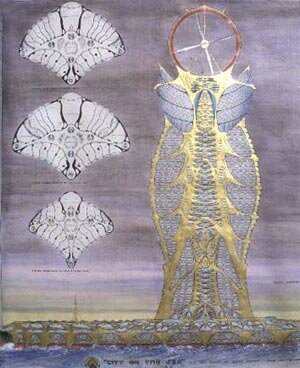
Eugene Tsui: City On The Sea
Links :
Vincent Callebaut
Lilypads
Nexus
Arcologies
Arcology Profound


